
An extendable oak dining table gives you extra space when you need it, without requiring a permanently large table in your dining room. Keep it compact for everyday meals, then open it for visiting relatives, birthday dinners or a weekend gathering with friends.
The right table should work comfortably in both positions. Its closed size needs to suit your household, while its extended size must leave enough room for chairs, serving and movement.
This guide explains how to choose an oak dining table that supports daily family life and occasional entertaining—without assuming every extending design offers the same capacity or features.
Choose for Everyday Family Life
Start with the number of people who use the table regularly. An extension is useful, but the table should not need opening for every ordinary meal unless you intend to leave it extended.
Think about how your household uses the dining area:
- Breakfast and evening meals.
- Homework and craft activities.
- Working from home.
- Board games and puzzles.
- Weekend meals with relatives.
- Occasional dinner parties.
Choose a closed size that accommodates these routines without crowding the room.
Plan for realistic guest numbers
Consider how often you entertain and how many additional seats you genuinely need. A table suitable for two extra guests may be a better fit than a much larger model bought for one annual celebration.
Do not assume that an extending table can accommodate any gathering. Seating capacity depends on its dimensions, chair widths, leg placement and the space needed for place settings and serving dishes.
For example, the Light Oak Extending Dining Table expands from 120cm to 160cm. That gives you two different footprints to plan around, rather than one permanently larger table. Check the product’s current seating guidance and complete specifications before ordering.
Account for extra chairs
An extension provides more tabletop space, but you still need somewhere for the additional seating.
Decide whether extra chairs will remain around the closed table, be used elsewhere in the home or require separate storage. Include their cost and footprint in the buying decision.
Measure Both Table Positions
Measure the dining area before choosing a table, including nearby doors, radiators and furniture. Then test the closed and fully extended layouts.
A table may fit when chairs are tucked underneath but become awkward when everyone is seated.
Use a floor plan you can test
- Mark the closed tabletop footprint with masking tape or cardboard.
- Position chairs around it.
- Pull each chair out as you would when sitting down.
- Walk between the table and nearby furniture.
- Repeat the exercise using the extended dimensions.
- Check access to the kitchen, doorway and other regularly used areas.
Where possible, around 90cm between the table edge and surrounding walls or furniture is a useful planning starting point. Chair dimensions and busy walking routes may require more space, so test the layout rather than relying on that figure alone.
Check delivery access too
Measure doorways, communal entrances, stair turns and lift openings where relevant. Ask about packaged dimensions and assembly requirements.
Getting the furniture into the room is a separate question from whether it fits once assembled.
Compare shapes
| Table shape | Why consider it | What to check when extended |
|---|---|---|
| Rectangular | Suits longer dining areas and seating along both sides | End-chair access and clearance along the room |
| Round extending | Provides a circular everyday arrangement | The longer footprint, which may become oval |
| Square extending | Can suit an evenly proportioned dining space | How the expanded shape changes circulation |
| Oval | Offers a longer surface with curved ends | Usable seating positions and base clearance |
Choose the shape around your room and routine, not simply its appearance in a product photograph.
Understand the Extension Mechanism
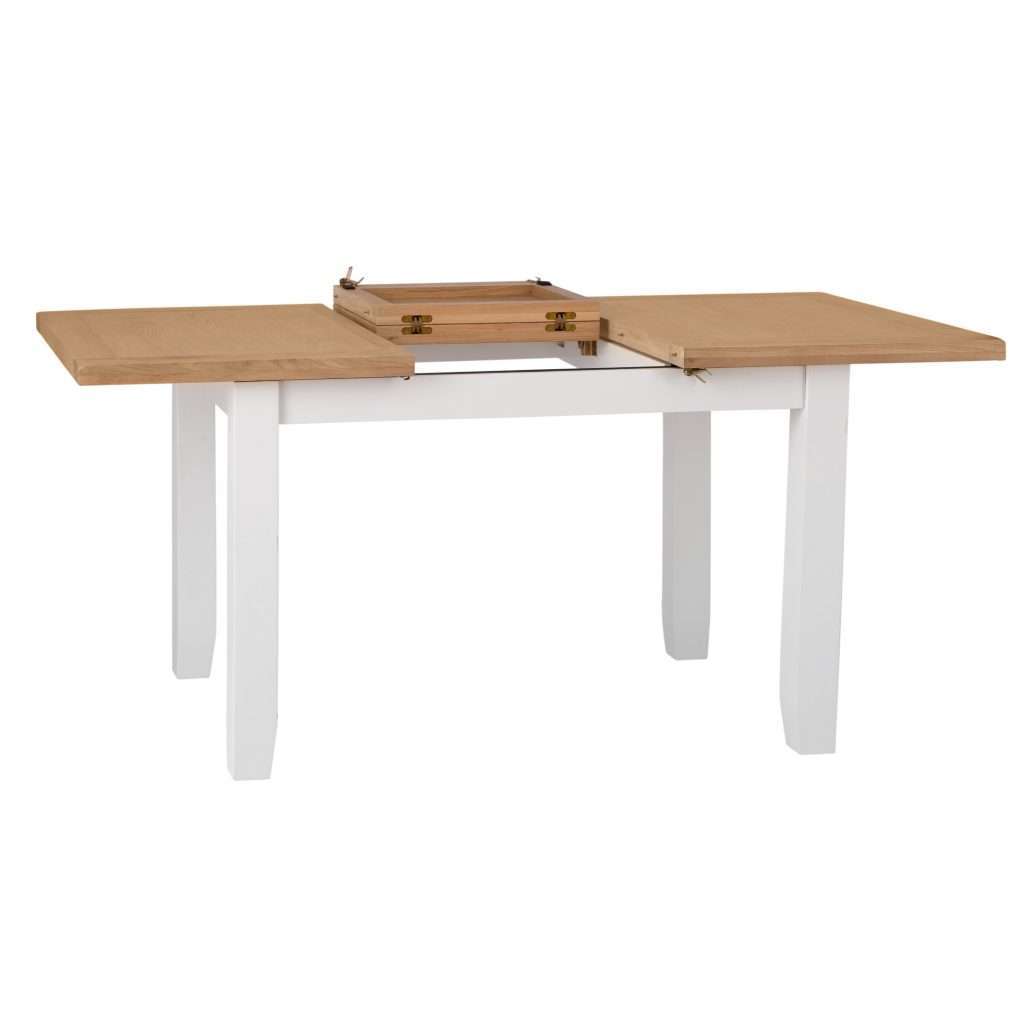
A mechanism should be straightforward enough that you are happy to use it. Confirm exactly how the individual table opens, where the leaves are kept and how the extended top is secured.
The original article mentions several extension types, including butterfly and separate leaves, but these are not interchangeable features supplied with every model.
| Extension type | How it generally works | Questions to ask |
|---|---|---|
| Butterfly leaf | A folded leaf opens into position, often from within the table | Does it store internally, and how is it operated? |
| Separate insertion leaf | The tabletop opens to accept an additional panel | Where will the leaf be stored when not in use? |
| End extension | Additional surface extends from an end of the table | Does the mechanism change chair or leg positions? |
Confirm operation before buying
Ask:
- Can one person operate it following the instructions?
- Does the base move as the table extends?
- Are the leaves stored inside or separately?
- Are locking fittings provided?
- How should the mechanism be maintained?
- What assembly is required?
Follow the manufacturer’s instructions when opening and closing the table. Keep fingers clear of moving joints, and make sure the tabletop is properly secured before setting out food or leaning on it.
Look beneath the surface
The table base affects seating in both positions. Check the distance between legs, underside clearance and any braces that could restrict knees or feet.
A pedestal is not automatically unrestricted, and a trestle base is not automatically the most stable option. Assess the actual design rather than choosing from a general label.
Match Chairs, Materials and Style
A good dining arrangement starts with compatible proportions. Chair comfort and access deserve as much attention as the table finish.
Check chair dimensions
Compare seat height, width and depth with the table specification. If the chairs have arms, check whether they fit beneath the tabletop and apron.
Browse our dining chairs to compare oak, painted and upholstered seating. Confirm the measurements and cleaning requirements of each option before combining it with a table.
A bench can create a relaxed arrangement, but check whether it fits between the legs and whether diners can get in and out independently. Do not assume it will tuck underneath simply because its overall length is shorter than the tabletop.
Read the material specification
“Oak dining table” does not necessarily mean solid oak throughout. Check the materials used in the top, frame, legs and extension leaves.
Solid timber and oak veneer have different characteristics, and neither description alone establishes the quality of the finished table. A suitable veneered construction can help broad panels remain stable; workmanship, finish and intended use still matter.
Also avoid treating oak as an automatic environmental guarantee. If timber sourcing or certification is important to you, request evidence for the specific product. The original article’s claim that choosing an oak table necessarily supports sustainable forestry is too broad.
Create a look that lasts
Choose a finish you enjoy with your existing room:
- Light oak with pale textiles and simple ceramics.
- Natural oak with woven textures and warm neutrals.
- Darker timber with lighter upholstery and surrounding finishes.
- Painted-and-oak furniture with a repeated accent colour.
You do not need identical table and chair finishes. Repeat a colour, texture or hardware detail to connect the pieces.
For a larger example to compare, the London Oak extending dining table is described as expanding from 140cm to 180cm. Its different closed and extended sizes may suit a different room or routine from a 120–160cm model.
Make Hosting and Care Easier
An extending table works best when the rest of the room supports it. Before guests arrive, open the table, position every chair and check the routes used for serving.
Keep the table comfortable
Use low decorations that do not block conversation, and leave enough surface space for place settings. A nearby oak sideboard can hold spare glassware, linen and serving pieces, or provide a separate area for drinks and desserts.
That can reduce crowding without needing to squeeze more items into the centre of the table.
Follow finish-specific care
Protect the top with coasters and suitable heat-resistant mats. Wipe spills promptly, avoid abrasive cleaners and follow the supplied care instructions.
Do not apply wood conditioner, oil or wax as a universal maintenance step. The original article recommends periodic conditioning, but the appropriate treatment depends on the table’s existing finish.
Keep extension leaves clean and dry, store them as instructed and do not lubricate or adjust the mechanism unless the manufacturer recommends it.
Your final buying checklist
Before ordering, confirm:
- The closed size suits everyday meals.
- The extended footprint fits with chairs in use.
- The stated seating capacity works with your chosen chairs.
- The extension mechanism is practical for you.
- Extra chairs and any separate leaves have storage space.
- Materials, finish and assembly requirements are clear.
- Delivery access is suitable.
- You understand the care, warranty and return terms.
An extendable oak dining table should adapt to your life without making the room harder to use. Explore our oak dining tables and dining chairs to find a combination that works for daily meals and the gatherings you enjoy most.