
A large oak dining table can become the heart of a dining room: somewhere for family meals, celebrations, homework and long evenings with friends. Its natural grain and substantial presence can anchor the space, but the most successful statement piece is one that feels comfortable to use—not simply impressive to look at.
Before choosing a table, consider how many people sit down every day, how often you entertain and how much room remains when the chairs are occupied. The right size should give everyone space without making movement around the room awkward.
This guide will help you compare oak dining tables, choose suitable seating and create a dining area that works for both everyday life and special occasions.
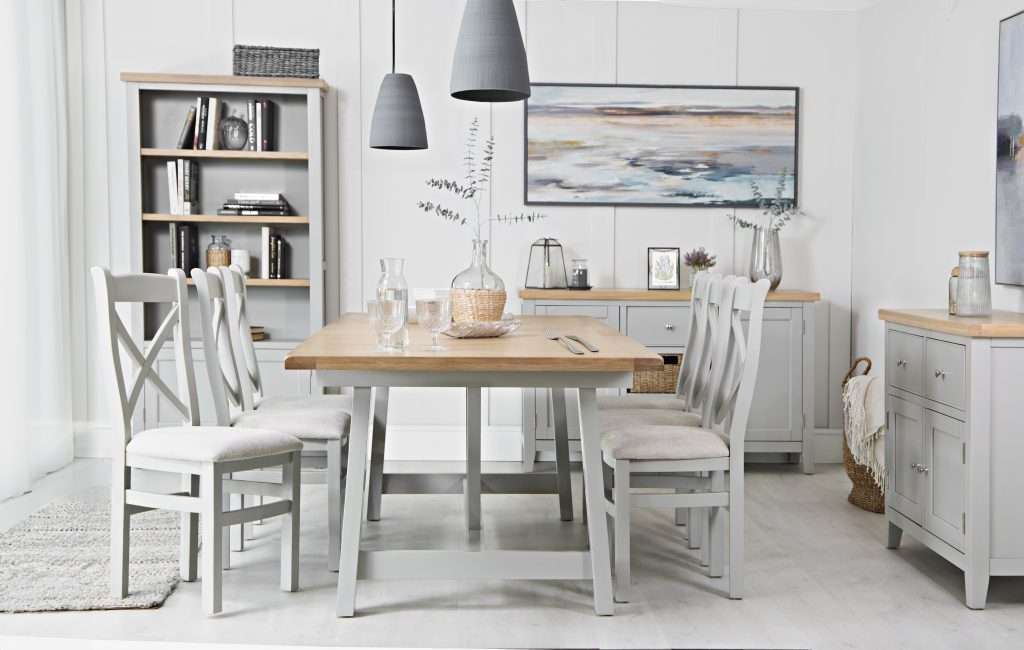
Decide How Much Table You Need
“Large” is a useful starting description, but it does not establish seating capacity. A table’s length, width, base and chair arrangement all affect how comfortably people can sit.
Start with your usual household size, then think about the gatherings you regularly host. Buying for an occasional extra guest is different from choosing a table for eight people every evening.
Plan for real meals
Consider what usually goes on the table:
- Individual place settings and water glasses.
- Serving dishes shared between diners.
- Children’s high chairs or booster seats.
- Homework, craft supplies or work equipment.
- Decorative objects you want to keep in place.
- Extra glasses and dishes for entertaining.
A table that accommodates the chairs may still feel crowded once food is served. Check the manufacturer’s seating guidance, but also consider the width of your chosen chairs and the amount of tabletop space you need.
Do not overlook width
Length receives most of the attention, but width matters too. It influences how much space remains between opposite place settings for bowls, platters and table decorations.
For example, the Smoked Oak Extending Dining Table is listed as 90cm deep, extending from 140cm to 180cm. Its product page also describes a solid-oak and oak-veneer construction, illustrating why complete specifications are more useful than the word “large” alone.
Use those dimensions to compare the furniture with your room and routine, rather than assuming a stated seat count guarantees comfort with every chair.
Measure With Chairs in Use
A large table needs enough surrounding space for people to sit down, stand up and move through the room. Measure the dining area before falling in love with a particular design.
Record:
- The room’s length and width.
- Doorways and their opening direction.
- Radiators, windows and fixed cupboards.
- Nearby sideboards or other furniture.
- Main routes to the kitchen, hallway or garden.
- The space needed behind occupied chairs.
Test the full footprint
Mark the tabletop dimensions on the floor with masking tape or cardboard. Position your existing chairs around the outline, pull them out and walk through the room.
Around 90cm between the table edge and surrounding walls or furniture is a useful planning starting point where possible. Busy walking routes, larger chairs or particular access needs may require more, so test the layout rather than treating that measurement as a universal rule.
For example, a 180cm-long table with approximately 90cm at each end requires about 360cm along that direction. You must also account for its width and the seating space on both sides.
If the room only works when every chair is tucked underneath, consider a smaller table or an extending design.
Check delivery access
Measure the route into the room, including front doors, hallways, stair turns and lift openings where relevant. Confirm packaged dimensions and whether the legs or tabletop arrive separately.
A table can fit the dining room but still present difficulties getting through the building. Resolve that before ordering.
Compare Shape and Extension
The right shape depends on the room’s proportions and how people move around it.
| Table type | Why consider it | What to check |
|---|---|---|
| Rectangular | A practical option for longer dining rooms and seating along both sides | End-chair access, leg positions and room clearance |
| Round | Creates a central gathering point without projecting tabletop corners | Diameter, chair spacing and room width |
| Oval | Offers a longer surface with curved ends | Usable seating positions and the complete footprint |
| Fixed | Straightforward for a consistent household or regular hosting | Whether its everyday size is comfortable |
| Extending | Adds space for guests without a permanently larger footprint | Closed size, extended size and leaf storage |
Choose fixed for a consistent layout
A fixed table can be a sensible choice when you regularly need its full seating capacity and have room for it. You do not need to operate an extension or store additional leaves.
However, keep the everyday layout in mind. A very large fixed table may be unnecessary if most meals involve only a few people and the room serves several purposes.
Choose extending for flexibility
An extending table can provide a smaller everyday arrangement and additional space for visitors. Check both footprints, along with the position of the legs when the table is open.
The London Oak extending dining table is described as expanding from 140cm to 180cm, offering two sizes within one design.
Before buying, ask how the extension operates, whether the leaf stores internally and where extra chairs will be kept. Follow the manufacturer’s instructions when opening, closing and securing the table.
Match Chairs and Construction
A statement table needs seating that works with it physically as well as visually. Wide chairs, arms and substantial table bases can all affect the number of comfortable places available.
Check beneath the tabletop
Compare chair measurements with:
- The space between table legs.
- Clearance beneath the apron.
- Pedestal or brace positions.
- Available knee and foot space.
- The table layout when extended.
Do not assume a pedestal allows unrestricted seating or that a bench will tuck underneath. Examine the actual dimensions and design.
Browse our dining chairs to compare oak, painted and upholstered options. Check each chair’s size, care requirements and suitability alongside your chosen table
Understand the materials
Read the specification for the tabletop, frame, legs and any extension leaves. An “oak dining table” may use solid timber, oak veneer, other materials or a combination.
Neither a photograph nor a material label tells you everything about quality. Construction, finish, assembly and intended use also matter. A suitable veneered construction can help broad panels remain stable; it should not automatically be dismissed as inferior to solid timber.
Useful questions include:
- What is each component made from?
- What finish protects the surface?
- How much assembly is required?
- What care instructions apply?
- What warranty and repair support are available?
Choose comfortable seating
If possible, try the chairs. When buying online, review seat dimensions, backrest design and return terms carefully.
A bench can create a relaxed look, but consider access for the people who will use it. Individual chairs may be more convenient where diners need to get up independently.
Create a Welcoming Dining Room
A large oak table already has visual presence. Build the room around it without adding so many competing features that the space feels crowded.
Keep styling simple
Try a low vase, a bowl or a linen runner for everyday decoration. Before serving a meal, remove anything that occupies needed space or interrupts conversation.
Connect the dining set to the room through a few repeated details:
- A chair colour echoed in artwork or cushions.
- Black frames paired with darker chair legs.
- Linen upholstery coordinated with curtains.
- Natural textures repeated in baskets or a rug.
- Warm metal accents used in lighting and accessories.
You do not need every wood finish to match exactly. A considered mix can feel more personal than a completely uniform room.
Give serving pieces another home
An oak sideboard can hold spare plates, glassware and table linen. During gatherings, it can provide a separate place for drinks or desserts, leaving more room at the table.
Measure the sideboard and dining arrangement together. Useful storage should not reduce the clearance needed behind the chairs.
Protect the finish
Use coasters beneath drinks and suitable heat-resistant mats under hot dishes. Wipe spills promptly and follow the table’s specific care instructions.
Do not apply oil, wax or polish unless recommended for its existing finish. Keep extension leaves clean and store them as instructed.
Find Your Large Oak Dining Table
The best large oak dining table is one that brings people together comfortably. Choose a size that fits with chairs occupied, a base that provides usable legroom and a construction and finish suited to your routine.
Explore our oak dining tables and dining chairs to create a dining space with presence, practicality and room for the occasions you enjoy most.