
Yes, you can use a sideboard as a TV stand, and in many UK living rooms it is the better choice. It gives you more surface, more storage and a calmer look than a typical TV unit. It works when four things are right: the sideboard is wider than the TV, it is the right height for your seat, it is stable and secured, and the back lets cables and warm air escape. This guide takes each in turn, then covers small rooms and what to look for in solid oak.
TL;DR
- A sideboard works as a TV stand if it is wider than the television, sits at a comfortable viewing height and is deep enough to hold the TV’s feet.
- Secure it to the wall, as UK home safety guidance advises for televisions and cabinets, especially if children or pets share the room.
- Leave breathing space around the TV and choose a sideboard with a cable cut-out or an open back.
- In a small room, a shorter sideboard with a wall-mounted TV above it saves floor space and keeps storage.
- Solid oak is heavy and stable, which suits a TV, but check the top’s depth and the shelf and drawer layout before you buy.
Table of Contents
- Can a sideboard really replace a TV unit?
- Getting the size right
- Make it safe: stability and securing
- Cables, heat and access
- A sideboard in a small living room
- Where to put it in the room
- Advantages and trade-offs, in practice
- Why solid oak suits a TV
- A sideboard built for the job
- Pre-purchase checklist
- FAQ
- Sources
Can a sideboard really replace a TV unit?
It can. A TV unit is designed around one job: holding a screen and a few boxes. A sideboard is designed around storage and surface, so it usually offers longer, cleaner lines, a deeper top and doors or drawers that hide everything you do not want to see. Many people already own one in the dining room or hallway and move it into the living room, or buy a new one specifically to take the TV.
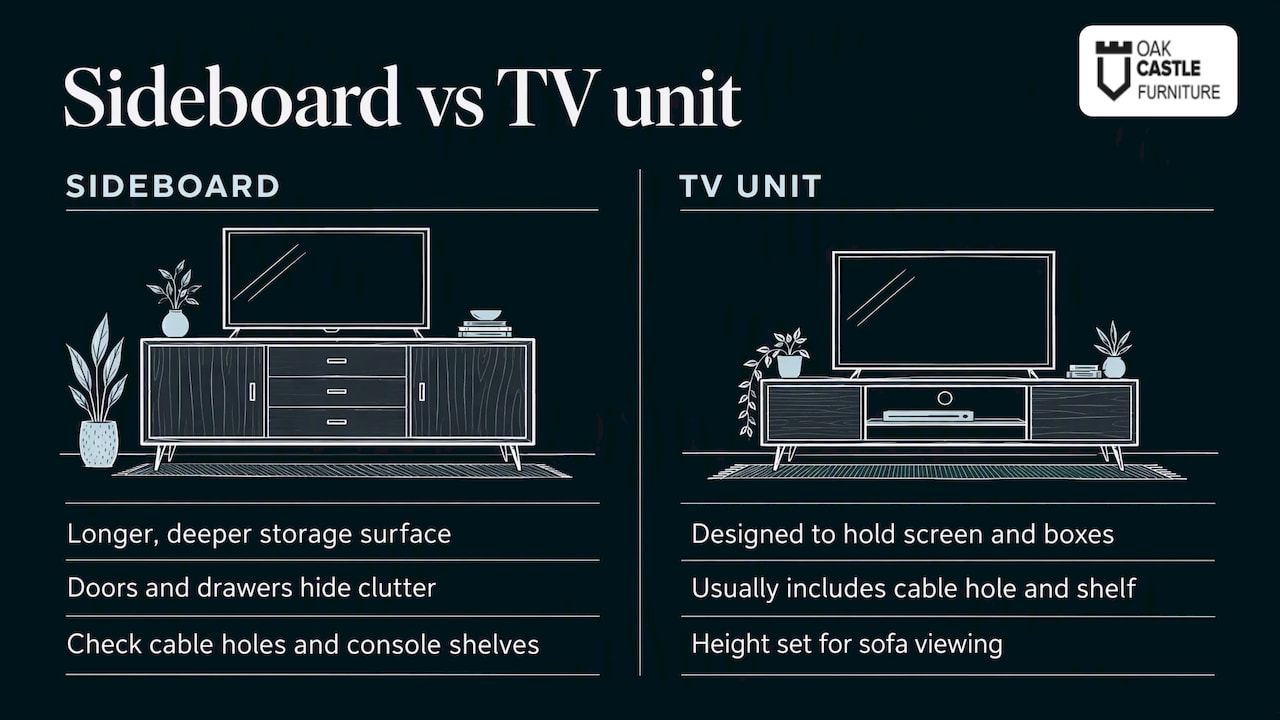
The difference is in the details a TV unit takes for granted. A purpose-built unit usually has a cable hole, a shelf for a games console and a height set for sofa viewing. With a sideboard you check those yourself. None of them is hard, and the sections below show what to measure.
Where a sideboard beats a TV unit
- Surface area. The top has room for the TV, a soundbar, a lamp and a few frames without looking crowded.
- Hidden storage. Closed doors keep controllers, board games, chargers and throws out of sight.
- Longevity. A good sideboard outlasts several TVs. When you change the set, the furniture stays.
- Flexibility. The same piece can move to a dining room or hallway later.
Where a TV unit is simpler
A dedicated TV unit is often lower and has pre-drilled cable routes. If you choose a sideboard, you are making up for that with a little planning. A sideboard that is too tall is the usual issue, which is covered next.
Getting the size right
Width: wider than the screen
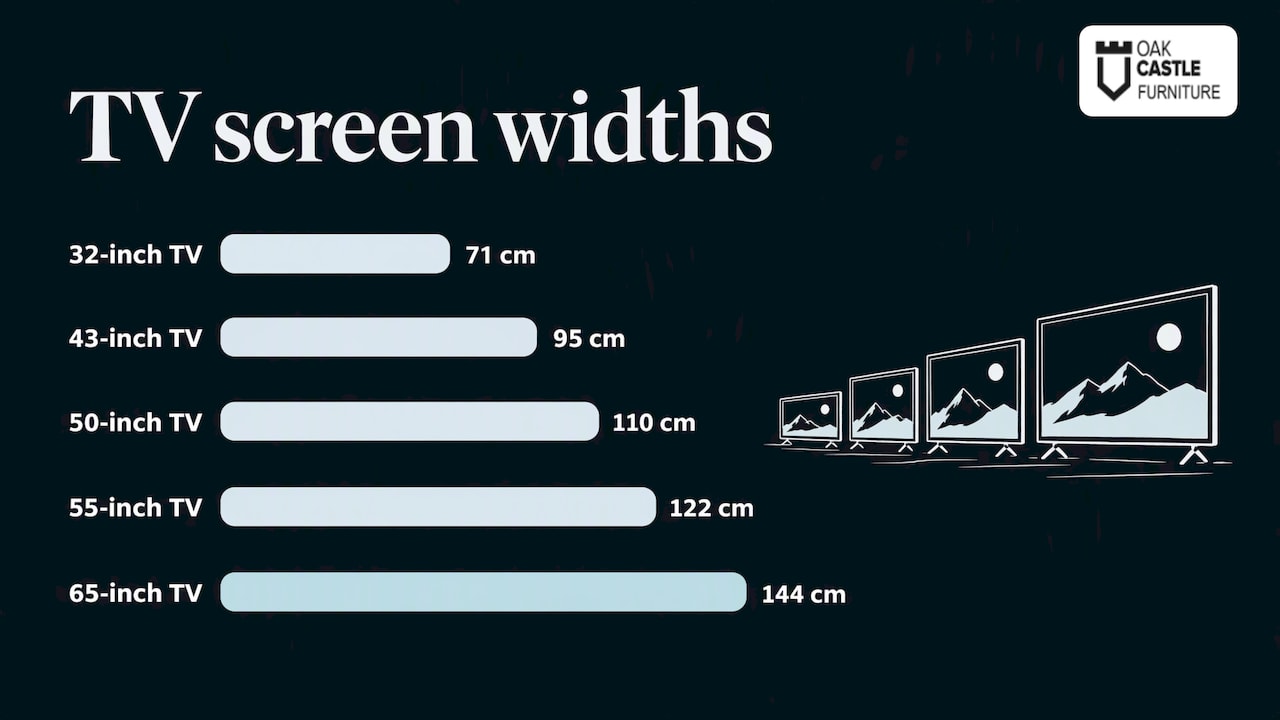
Measure the TV itself, not the box. A modern 16:9 screen is roughly 87% as wide as its diagonal, so a 55-inch set is about 122 cm across and a 43-inch set about 95 cm. Always confirm on the manufacturer’s specification, since bezels and feet differ.
The sideboard should be longer than the TV so the set does not look as if it is about to tip off the ends. A forum answer from interior decorating enthusiasts puts it simply: the cabinet should be longer than the TV by a couple of inches. We would go further. Aim for at least 10 to 15 cm of spare top on each side for a balanced look. That means:
| TV screen size | Approx. screen width | Sideboard length to aim for |
|---|---|---|
| 32 inch | 71 cm | 100 cm or more |
| 43 inch | 95 cm | 110 to 140 cm |
| 50 inch | 110 cm | 130 to 160 cm |
| 55 inch | 122 cm | 140 to 170 cm |
| 65 inch | 144 cm | 160 cm or more |
These are our guide figures from simple geometry and what looks balanced in a room, not a rule. If you plan to add a soundbar or speakers on the top, add more length.
If your wall can take it, a 140 cm sideboard is a sweet spot for a mid-sized TV with room to spare; our 140cm sideboard ideas show how it looks in living and dining rooms.
Depth: can it hold the feet?
Check the depth of the top against the TV’s stand. Most televisions have either two feet at the far edges or a central pedestal. Feet need to sit fully on the surface, with a little margin at the front. If the feet are set wide, the sideboard needs to be long enough to take them. If the pedestal is deep, check that front-to-back depth allows it.
Height: think about your eyes, not the TV
Sideboards are often taller than TV units, and this is the mistake that causes neck ache. Sit on your sofa and measure the height of your eyes from the floor. The middle of the screen should sit roughly at that level, or a little below. Add the sideboard height to the TV’s own height (feet to the screen’s centre) and compare.
As a rule, lower sideboards suit TV use, while taller ones suit dining rooms and hallways. Our guide on what height a sideboard should be goes through typical heights and where each works. If you like the look of a taller cabinet, read our take on extra tall TV cabinets before you commit.
If the sideboard is on the tall side, mounting the TV on the wall and using the sideboard purely for storage is often the answer. See the next section on mounting options.
Make it safe: stability and securing
A TV is top-heavy, and a sideboard holding one is carrying weight high up. This is the part not to skip.
Secure the furniture to the wall
Home safety guidance in the UK is clear on the principle. A Lancashire County Council document on injuries from unsecured furniture advises that you attach, mount, bolt or otherwise secure furniture to walls and floors. A safeguarding partnership booklet for homes with under-fives says that bookshelves, drawers, televisions and fireplaces should be secured to walls.
In practice, that means:
- Fit anti-tip brackets or straps between the back of the sideboard and the wall, into a stud or with fixings suited to your wall type.
- Strap the TV to the sideboard or wall if it stands on its feet, using the manufacturer’s recommended kit.
- Keep the heaviest items low, in the cupboards, and not on the top.
- Do not let children climb or hang on open drawers.
If you are unsure about drilling into your walls, particularly plaster or older lath walls, ask a qualified handyperson. Do not guess at fixings.
Check the weight
Compare your TV’s weight, found in its manual, with the maker’s stated load for the sideboard top. Where a maker gives no figure, solid oak with a thick top and a sound frame generally carries a modern flat-screen set comfortably, but ask the seller if you are unsure. Be more careful with veneered boards, thin tops or sideboards with long unsupported spans, and with older pieces whose joints have loosened.
Consider a wall-mounted TV
Mounting the TV frees the top of the sideboard and removes the tipping risk of the TV itself. The wall bracket has to match your TV’s VESA pattern and weight and be fixed into suitable wall material. Some people prefer to hang the TV from above; a ceiling TV mount is rated for a stated maximum load, so check your set’s weight against that figure first. For most living rooms, a wall bracket above a sideboard is the neater solution, and our piece on pairing a 70cm sideboard with a wall-mounted TV shows how the pair works in a compact room.
Cables, heat and access
Ventilation
TVs, set-top boxes and consoles give off heat. Manufacturers say so in their manuals: one TCL manual, for example, advises leaving more than 10 cm clearance around the television for adequate ventilation. Check the manual for your own set, since figures differ by model.
For a sideboard, that suggests:
- Do not push the TV flush against the wall behind it, and keep some gap above it. Do not place a shelf or a cabinet directly over the top.
- Put boxes and consoles on a shelf with open sides or an open back, not in a sealed cupboard.
- Leave doors ajar or choose open compartments for heat-producing kit.
- Keep fabric, books and ornaments off the vents of a set.
Cable routes
Most sideboards have a solid back. You have three options:
- Cable cut-out. Many sideboards have a hole or slot in the back panel. Check for one before buying, or ask the seller whether one can be added when ordering a made-to-order piece.
- Gap behind the unit. Leave a gap of a few centimetres between the wall and the back, enough for plugs and a socket extension.
- Cable management. Cable sleeves, clips and a trunking strip on the wall tidy the run to the nearest socket. Use a surge-protected extension rather than daisy-chaining sockets.
Our guide to smart sideboard storage with a 110cm unit covers how to organise a tidy tech hub inside the cupboards.
Remote controls and access
Wooden doors can block infrared remotes. If your set-top box uses IR, leave its compartment open, use a Bluetooth or RF remote, or fit an IR repeater. Soft-close doors are pleasant, but test that the doors will open fully enough to reach the back of the boxes. Drawers are useful for discs, controllers and cables, so do not give them all to kit.
A sideboard in a small living room
Small rooms are where a sideboard can make the most sense. Instead of a TV unit plus a separate storage cabinet, one piece does both. A few principles help:
- Go shorter, not necessarily smaller. A 100 cm sideboard suits a 32 to 43 inch set in a flat or a bedroom. See our look at the 100cm sideboard for compact urban spaces.
- Wall-mount the TV. This saves depth on the top and keeps the sightline clear. A narrow 70 cm sideboard under a wall-mounted TV is a neat solution for a tight alcove; styling a narrow 70cm sideboard shows real UK rooms.
- Choose legs or a lighter finish. A sideboard on slim legs, or in a light oak, shows the floor beneath it and feels airier.
- Use doors rather than open shelves to stop visual clutter in a small space.
- Mind the walkway. Leave enough room to open doors and drawers and to walk past. Think about how far the depth sticks into the room.
Our wider advice on small space living with an oak sideboard goes through more layouts, and if a sideboard just will not fit, there are sideboard alternatives for compact spaces.
Where to put it in the room
The TV wall should avoid direct window glare, and the sofa should sit within a comfortable viewing distance. Do not place the sideboard over a radiator, as heat can dry out wood and warm the TV from below. Leave space to reach sockets. For layouts in other rooms, such as a dining room or hallway, our room-by-room sideboard placement guide is a good companion.
Advantages and trade-offs, in practice
| What you want | Sideboard | Typical TV unit |
|---|---|---|
| Plenty of surface for decor | Large top | Often a smaller top |
| Closed storage | Doors and drawers | Mixed open and closed |
| Built-in cable routes | Check for a cut-out | Usually included |
| Height for sofa viewing | Check before you buy | Usually set low |
| Use later in another room | Very flexible | Less so |
The trade-off is mostly planning: measure the height, ask about the cable route and decide on mounting. Do those three things and the sideboard is a long-term piece that ages well.
Why solid oak suits a TV
Oak is dense and strong, and it takes a TV’s weight without flexing the way thin boards can. It also ages well, and a good finish hides everyday marks. We make solid oak and oak and veneer furniture, with bespoke and ready-made options in a range of finishes. When you choose, look at:
- Top thickness and overhang. A thick top gives a stable base for the TV’s feet.
- Finish. Light oak brightens a small room, while smoked oak gives depth and a modern feel.
- Interior layout. Choose shelves for boxes and drawers for small items.
- Assembly. If you would rather not build furniture, check what level of assembly is offered when you order.
Our view: why a sideboard makes a good media console
We have seen the same pattern for years. Customers come looking for a TV unit and leave with a sideboard, because they realise they want one piece that does the work of two. A sideboard asks you to think about the room and not just the screen, and the room is better for it.
Our approach is to treat the TV as one part of the living space. We build in solid oak, which is stable enough for the job and looks right whether the screen is on or off. We also make pieces to order, so the finish, size and details can suit the home, not the other way round. That matters most in small rooms and awkward alcoves, where an off-the-shelf size rarely fits.
Our advice is simple: measure the TV, check the height against your seat, secure the piece to the wall and plan the cables before you order. Then choose a sideboard you would be happy to keep when the TV changes.
Julie Love
A sideboard built for the job
If you are ready to choose, start with our oak sideboards and TV units. We offer solid oak and oak and veneer pieces for living rooms, made to order and customisable in finish and assembly, for homes and for commercial spaces.
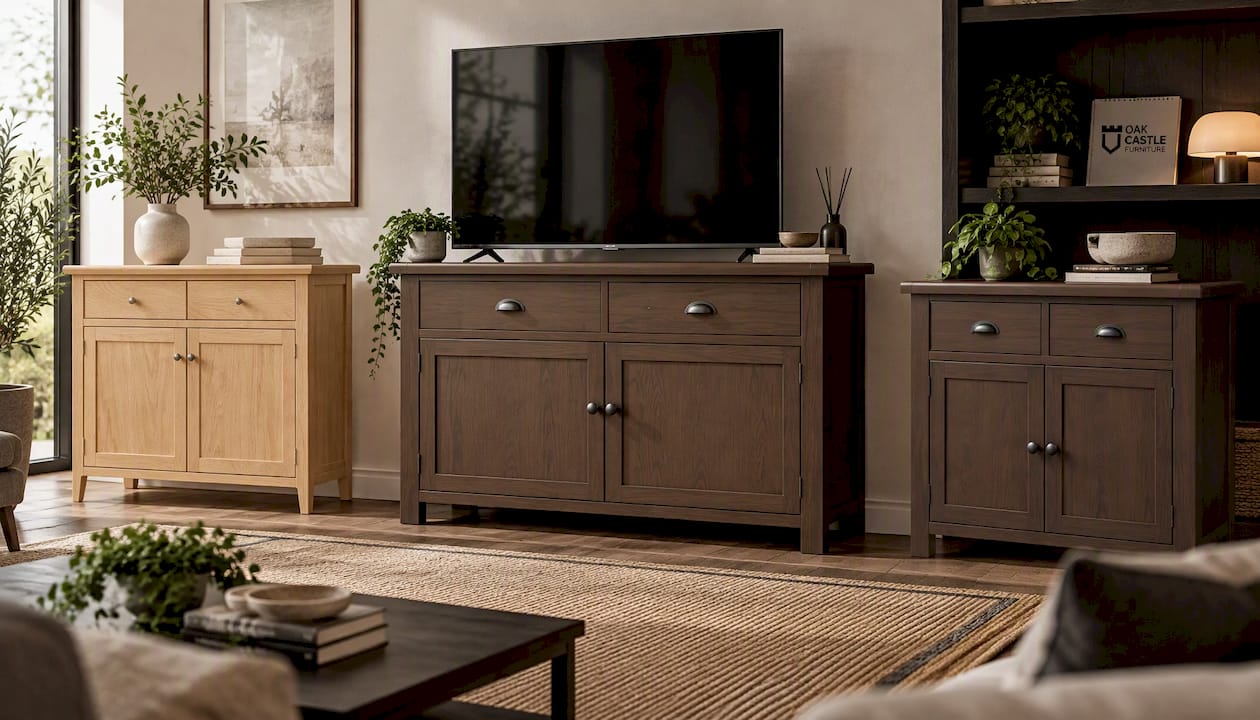
For a smaller room, the small sideboard in light oak or the smoked oak small sideboard are good places to begin. If you need more length for a larger screen, look at the smoked oak standard sideboard. Check each product page for current dimensions and prices.
Pre-purchase checklist
- Measure your TV’s width, height with feet and weight.
- Choose a sideboard at least 10 to 15 cm longer on each side than the TV.
- Check the combined height against your seated eye line.
- Confirm the top is deep enough for the TV’s feet.
- Plan wall fixings or anti-tip brackets for the sideboard.
- Look for a cable cut-out or leave a gap behind.
- Keep ventilation space around the TV and the boxes.
- Check door and drawer clearance in the room.
FAQ
Can any sideboard be used as a TV stand?
Not quite any. It needs a top that is longer than the TV, deep enough for its feet, and strong enough for its weight. The height should also suit your seated eye line. If the sideboard passes those tests, and you secure it to the wall, it will do the job well.
How wide should a sideboard be for a 55-inch TV?
A 55-inch screen is about 122 cm wide, so we would suggest a sideboard of 140 to 170 cm. That gives you spare top on each side for balance and for a soundbar or lamp. Check your own TV’s width in its manual, as models vary.
How do I hide the cables?
Choose a sideboard with a cable cut-out in the back, or leave a small gap to the wall. Run the cables through to a surge-protected extension behind the unit. Wall trunking or sleeves tidy the rest of the run to the socket.
Do I need to fix a sideboard to the wall?
We recommend it. UK home safety guidance advises securing furniture and televisions to walls, particularly where there are young children. Use anti-tip brackets and fixings suited to your wall, or ask a handyperson if unsure.
Can I put a games console inside a closed cupboard?
Only if the heat can escape. Consoles and boxes warm up, so use a shelf with an open back or open sides, and leave doors ajar while in use. Check the manufacturer’s manual for its recommended clearance.
Sources
- Accidents in the home: injuries from unsecured furniture (Lancashire County Council)
- Safe at Home booklet for under-5s (Children’s safeguarding partnership)
- TCL C645 user manual: Important information
- Ceiling mount for TV or monitor, up to 30 kg