
If you’ve chosen a 70cm-wide sideboard, you’ve already solved the hardest part: fitting stylish storage into a compact UK home. The next step is making it look intentional, not squeezed in.
This guide shows you exactly how to style a narrow 70cm sideboard in small dining rooms, hallways and living rooms, with layouts you can copy and adapt.
Looking for options? Browse our full range of 70cm-wide sideboards to find the right size, finish and storage configuration for your space.
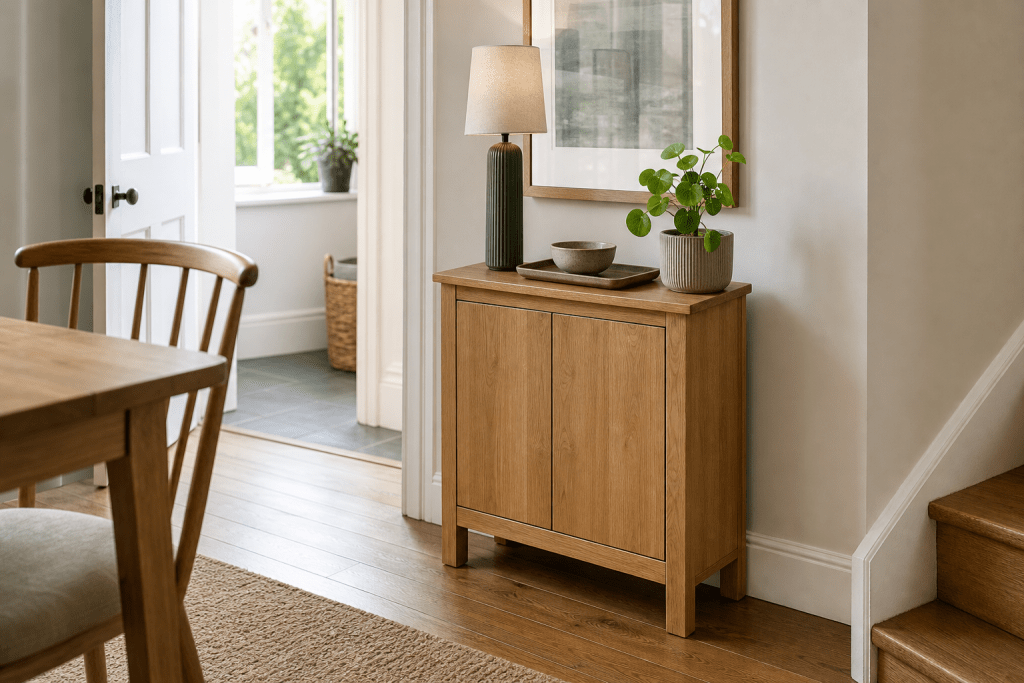
Why a 70cm Sideboard Works in Small UK Homes
A 70cm width is ideal when:
- You have a short wall between a door, radiator or window.
- You’re furnishing a compact dining area in a terrace or semi.
- You want a slim console in a hallway without blocking the route to the stairs.
- You need extra storage in a small living room but don’t want a bulky unit.
Because the footprint is modest, the styling needs to work harder to make the piece feel considered and “designed”, not just functional.
Core Styling Principles for Narrow Sideboards
1. Use the “Rule of Three”
Designers often group items in threes because it feels balanced without being symmetrical. For a 70cm sideboard, try:
- One item for height – a tall lamp, candlestick or vertical vase.
- One item for practicality – a tray, bowl or box for keys, mail, remotes.
- One item for personality – a framed print, small sculpture or plant.
On a narrow surface, this keeps the top clear enough to use while still looking styled.
2. Go Vertical to Counteract the Narrow Width
A 70cm sideboard is compact horizontally, so you want to draw the eye upward:
- Choose a tall table lamp or floor lamp beside it.
- Hang a mirror or artwork above, centred over the sideboard.
- Use tall vases or stacked books to add height without taking extra floor space.
This makes the whole arrangement feel more substantial than the footprint suggests.
3. Balance Symmetry and Asymmetry
- In a hallway or entryway, symmetry often looks neater: matching lamps or vases at each end, with a central tray or bowl.
- In a dining or living room, a slightly asymmetrical layout can feel more relaxed: a lamp to one side, a stack of books and a plant to the other, with a central decorative object.
With only 70cm to play with, avoid more than three or four key objects on top.
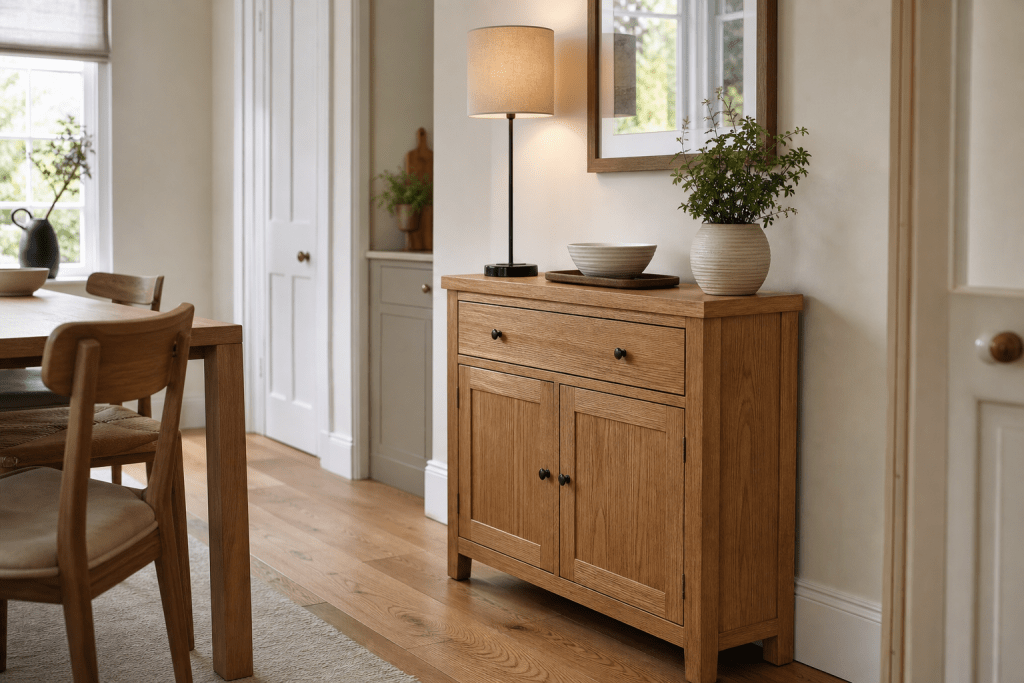
Layout Ideas by Room
1. Small Dining Room: Mini Buffet & Display
In a compact dining room, a 70cm sideboard often sits against a short wall or in an alcove.
Suggested layout:
- Left: Tall lamp or candlestick for height and evening ambience.
- Centre: A shallow tray with a small vase of flowers or a decorative bowl.
- Right: Stack of 2–3 coffee table books with a small plant or object on top.
- Above: A mirror or framed print centred over the sideboard to reflect light and add visual height.
Function:
- Use drawers/cupboards for table linens, candles, serving plates.
- Keep the top clear enough to set down plates when serving.
This turns your 70cm unit into a proper dining-room focal point without overwhelming the room. If you’re unsure about dimensions, see our guide on how to measure a tight space for a 70cm sideboard (internal link – add once published).
Need ideas? Explore our 70cm-wide sideboards in oak, painted and mixed finishes to match your dining room style.
2. Hallway / Entryway: Console-Style Styling
In many UK homes, a 70cm sideboard works perfectly as a hallway console near the front door.
Suggested layout:
- Left: Tall lamp or slim vase with dried branches.
- Centre: A shallow tray for keys, post and sunglasses.
- Right: Small plant or decorative object (e.g. ceramic bowl).
- Above: A mirror to bounce light down the hall and help with last-minute checks before leaving.
Function:
- Top drawers for mail, dog leads, masks, gloves.
- Lower cupboards for shoes, bags or bulkier items.
Because hallways are narrow, keep decor low-profile so it doesn’t encroach on the walking route. Aim for at least 75–90 cm of clear space in front of the sideboard so doors and drawers can open comfortably.
3. Living Room: Slim Storage + Display
In a small living room, a 70cm sideboard can act as a compact credenza next to a sofa or under a window.
Suggested layout:
- One end: Table lamp for reading light.
- Other end: Stack of books with a small plant or sculpture.
- Centre: A decorative bowl or tray for remotes, coasters, candles.
- Above: A piece of artwork or a shelf with a few curated objects.
Function:
- Store board games, magazines, blankets or media accessories inside.
- Use the top as a surface for drinks when entertaining, or as a coffee/tea station.
If you’re using it as a TV alternative, choose a low-profile 70cm sideboard and ensure the height works with your seating; our guide on what height should a sideboard be goes into this in detail.
Styling by Function: Beyond “Just Storage”
A 70cm sideboard can be more than a place to hide clutter. Consider these roles:
Mini Bar / Drinks Station
- Top: Decanters, glasses on a tray, small ice bucket.
- Inside: Bottles, bar tools, napkins.
- Add: A small framed print or neon sign above for a “bar” feel.
Home Office Support
As we’ve explored before, a 70cm sideboard can support a home office setup:
- Top: Printer, paper tray, charging station.
- Drawers: Files, stationery, cables.
- Above: Inspirational prints or a small gallery wall.oakcastlefurniture.co
This is especially useful in small bedrooms or living rooms where a full desk doesn’t fit.
Coffee / Tea Station
- Top: Coffee machine or kettle, mugs on a tray, jars for coffee/tea/sugar.
- Inside: Extra mugs, filters, teabags, cleaning cloths.
- Above: Simple artwork or a small shelf with plants.
Common Styling Mistakes to Avoid
- Overcrowding the top. On 70cm, more than 4–5 objects will look fussy and make the surface unusable.
- Ignoring height. Flat, low objects make the sideboard look smaller; add at least one tall element.
- Forgetting function. If you can’t put down a cup or a plate, it’s styled but not practical.
- No link to the room. Ensure colours, materials and objects echo the rest of the space (e.g. oak tones, metal finishes, paint colours).
Quick Styling Checklist for a 70cm Sideboard
Use this as a quick reference:
- One tall item (lamp, vase, candlestick).
- One practical item (tray, bowl, box).
- One personality piece (plant, art, object).
- Something above (mirror, print, shelf).
- Clear surface to actually use (at least 30–40 cm free).
- Storage inside matched to function (dining, hallway, living, office).
Next Steps: Choose the Right 70cm Sideboard for Your Space
Once you know how you want to use and style your sideboard, the next step is choosing the right design and finish.
- Browse our full collection of 70cm-wide sideboards to compare heights, depths and storage configurations.
- If you’re unsure it will fit, read our step-by-step guide: How to Measure a Tight Space for a 70cm Sideboard (add internal link once published).
- For style matching, see: Which Interior Design Styles Suit a Compact 70cm Sideboard? (add internal link once published).
With the right proportions and a simple three-object layout, a narrow 70cm sideboard can become one of the most useful and stylish pieces in your home.