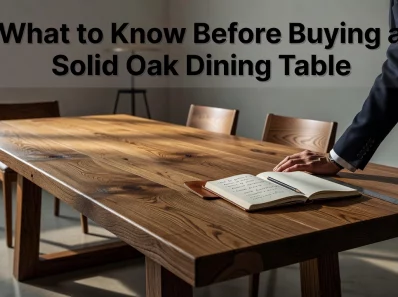
A hand-crafted oak dining table is worth considering when you want careful construction, a particular design or options that a standard range cannot offer. But the label alone does not guarantee quality. Ask what the maker does by hand, what the table is made from and how its construction supports everyday use.
What does hand-crafted mean?
Sellers use hand-crafted, handmade and hand-finished in different ways. Ask which stages involve skilled manual work: selecting boards, cutting joints, assembly, sanding or applying the finish. Machine tools can be part of a craft workshop; their use alone does not tell you whether a table is well made.
Do not infer the process from a rustic appearance or decorative carving. A plain table can involve considerable skilled work, while a carved detail may be machine-produced. Workshop photographs and a specific description of the build tell you more than a general craftsmanship claim.
Hand-crafted is not always bespoke
A hand-crafted table may be a standard design. Made-to-order usually describes when production starts, not unlimited design freedom. Made-to-measure may mean changing the dimensions of an existing design, while bespoke can involve a design developed around your requirements. Confirm the seller’s meaning and the available changes in writing.
If you commission a table, agree its dimensions, materials, base, edge profile and finish before work begins. Ask for drawings and a finish sample where available, plus an explanation of natural colour and grain variation. A sample guides expectations; it does not guarantee that every board will match.
Construction checks that matter
Ask whether the top and base are solid oak, oak veneer or mixed materials. “Oak table” is not a complete specification. Request an underside photograph and details of the joints and fixings; a thick-looking edge does not prove a thick solid-wood top.
For a solid-timber top, ask how it is attached to allow seasonal movement. Wood expands and contracts as moisture conditions change, particularly across the grain. Appropriate fixings let the top move while remaining securely supported; rigidly restraining a wide top can cause problems.
Inspect or ask about stability, joint fit, smooth edges and the consistency of the finish. On an extending table, confirm that the mechanism works smoothly and that the leaves align. Traditional joints can be useful, but a named joint alone is not proof of sound execution or long life.
Choose design around daily use
Think about how the table will be used, not just its style. A chunky farmhouse base can affect end-seat legroom; an apron beneath the top can obstruct chair arms. Compare the usable space between the legs and beneath the top with your actual chairs.
For a custom order, include those clearances in the agreed specification. If the table also serves as a desk, discuss surface smoothness and edge comfort. If you host regularly, decide whether you need a fixed top or extension leaves, and where any separate leaves will be stored.

Judge the price by the work
Compare like-for-like quotations: dimensions, timber construction, finish, delivery and assembly. Ask what a higher price buys, such as a specified design change, more detailed joinery or a documented repair service. Hand-crafted does not automatically mean better than a well-designed standard table.
Before paying, confirm lead time, deposit and payment stages, what happens if the specification changes, delivery access and the seller’s cancellation and return terms. Do not assume a customised order has the same arrangements as a stocked table. Obtain the guarantee and aftercare commitments in writing.
Durability needs care and repair
Oak can be a durable furniture material, but no table is guaranteed to last generations simply because it is hand-crafted. Construction, indoor conditions, finish and maintenance all affect its service life. Ask whether damaged parts can be repaired and whether the maker provides aftercare advice.
Follow the instructions for the actual finish. Remove spills promptly, use heat-resistant mats and avoid abrasive cleaning. Do not routinely oil or wax a lacquered surface unless the supplier recommends it. Seek advice before sanding, especially where veneer, filler or a colour treatment is involved.
Compare available dining tables
Use this guide to assess specific products rather than assume a whole range is handmade or customisable. Browse our oak and wooden dining tables, then check each listing’s materials and dimensions. Compare dining chairs against the table’s usable clearances. Ask about manufacturing or customisation only where those details are confirmed for the item you want.