
Demystifying Veneer vs. Solid Wood
The veneer debate confuses many furniture buyers. Common misconceptions persist: “Veneer means cheap,” “solid wood is always better,” or “veneered furniture is low quality.” These assumptions lack nuance and often lead to poor purchasing decisions.
The reality is more sophisticated. Strategic veneer use in quality furniture represents technical excellence, not cost-cutting. Meanwhile, poor-quality solid wood can underperform. Understanding the genuine distinctions helps you evaluate sideboards on actual quality rather than material assumptions.
This guide provides clarity about construction methods, their durability implications, and how to identify quality regardless of whether pieces use veneers or solid wood.
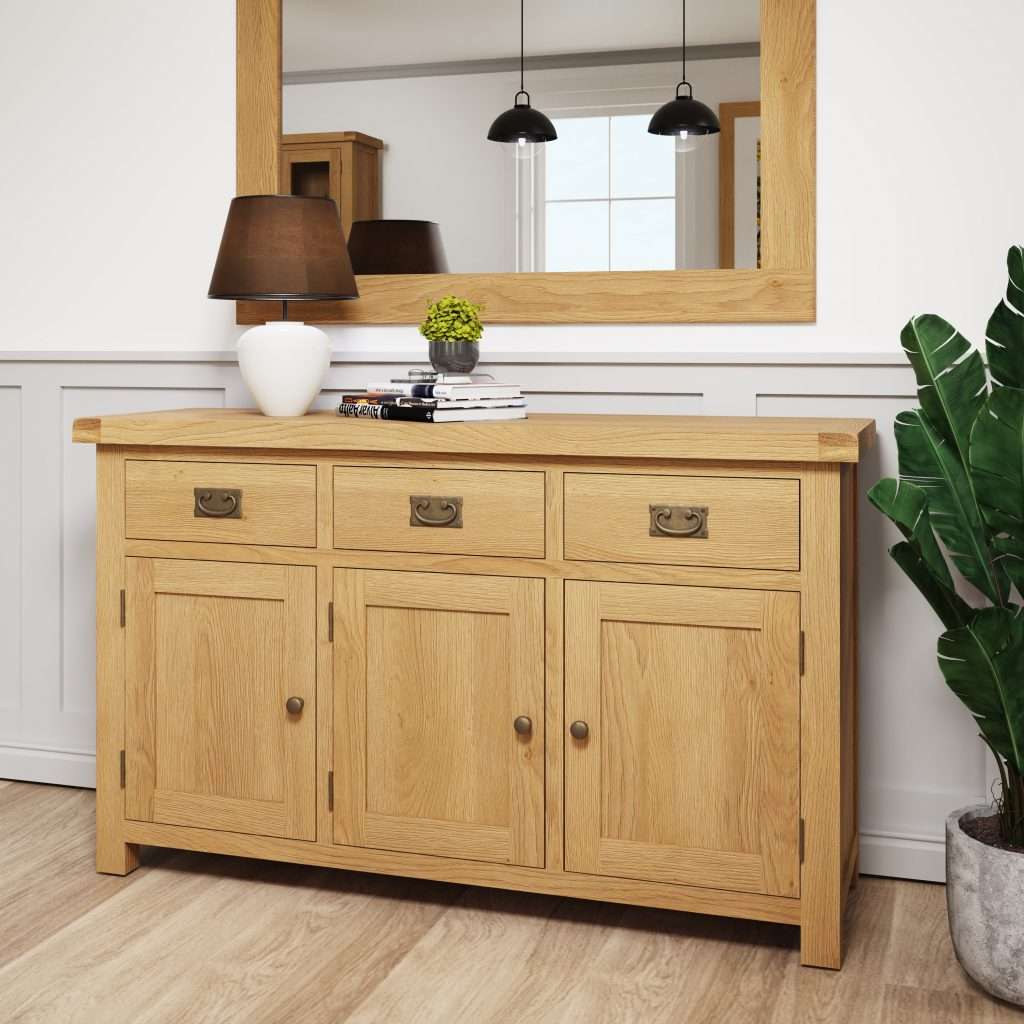
What Is Veneer? Understanding the Technical Reality
Veneer Definition and Construction
Veneer is a thin layer of premium wood—typically 1-3mm thick—bonded to a stable substrate. The substrate is usually quality plywood (not particleboard or MDF, though budget alternatives exist).
Historical Context: Veneer isn’t modern innovation. Sophisticated craftspeople have used veneers for centuries. Museum-quality period furniture frequently features veneered surfaces created by master artisans. The technique’s longevity proves that veneer, when executed properly, delivers genuine quality.
Why Furniture Makers Use Veneers (The Technical Explanation)
Understanding the “why” reveals veneer’s actual purpose:
Problem: Wood Movement Solid oak expands and contracts seasonally due to humidity fluctuations. On large surfaces, this movement creates internal stress that can exceed wood’s structural capacity, resulting in splitting, warping, and cracking. This isn’t manufacturing failure—it’s physics.
Oak grain structure means it expands more across the grain than along it. A 60-inch-wide tabletop expands and contracts differently at different points, creating internal conflict that solid wood cannot always withstand, especially over decades.
Solution: Strategic Veneer Use A veneered surface consists of premium oak veneer adhered to a stable plywood substrate. The plywood remains dimensionally stable regardless of humidity changes. The veneer provides authentic oak appearance and grain characteristics. Together, they create a surface that:
- Maintains dimensional stability
- Resists warping and splitting
- Provides authentic oak appearance and feel
- Lasts longer than solid wood would in identical conditions
This isn’t compromise—it’s enhancement. Master furniture makers deliberately choose veneered construction for large surfaces specifically because it delivers superior durability.
Quality Veneer vs. Budget Veneer: The Real Distinction
Here’s where the confusion actually matters: quality veneers and budget veneers are fundamentally different products.
Quality Veneer Characteristics
Substrate Quality:
- Premium plywood with multiple laminated layers
- Genuinely stable and durable
- Resistant to warping or delamination
- Typically uses 5-7mm thickness for stability
Veneer Quality:
- Premium hardwood (authentic oak, not printed pattern)
- Thicker application (2-3mm) allowing future refinishing
- Grain-matched for aesthetic continuity
- Professional adhesive bonding using modern techniques
Construction Method:
- Vacuum pressing or hand-laid techniques
- Quality adhesives that cure properly
- Smooth, seamless bonds between veneer and substrate
Longevity:
- 30-40+ year lifespan with minimal deterioration
- Refinishable if damage occurs
- Substrate remains protected and structurally sound
Budget Veneer Problems
Substrate Quality:
- Thin particleboard or low-grade plywood
- Lacks dimensional stability
- Prone to warping or swelling with humidity changes
Veneer Quality:
- Paper-thin veneer (0.5-1mm), impossible to refinish
- Often printed oak-pattern rather than authentic veneer
- Poor adhesive bonding prone to peeling or separation
- Grain matching ignored or inconsistent
Construction Method:
- Mechanical fastening rather than proper adhesive bonding
- Insufficient pressure application
- Poor quality control during manufacturing
Longevity:
- 3-7 year lifespan before significant deterioration
- Veneer peels, separates, or damages easily
- Cannot be refinished once surface is compromised
Solid Oak: When It Works and When It Doesn’t
Where Solid Oak Excels
Solid oak works exceptionally well in specific applications:
Structural Components: Legs, frames, and support structures benefit from solid oak’s strength. Solid construction here provides durability and authentic weight that customers appreciate.
Small Surfaces: Small panels, drawer fronts, and decorative elements don’t experience sufficient wood movement to cause problems. Solid oak here provides authentic appearance without technical compromise.
Visible Elements: When oak’s authentic appearance is important and wood movement won’t cause problems, solid construction delivers genuine beauty and customer satisfaction.
Where Solid Oak Becomes Problematic
Large flat surfaces are where solid oak creates genuine challenges:
Large Tabletops: A 60-72 inch solid oak tabletop experiences wood movement that can exceed structural limits, leading to:
- Cupping (edges higher than center)
- Bowing (surface curves)
- Splitting along grain lines
- Warping that makes drawers difficult to operate
Large Cabinet Sides: When applied to wide sideboard sides or door panels, solid construction can result in visible warping over time, especially in variable humidity environments.
Extended Use: Wood movement increases with age and seasonal variation. A solid oak piece that remains stable for 5 years might develop problems by year 10-15 due to cumulative stress.
Direct Comparison: Veneer vs. Solid on Large Surfaces
| Characteristic | Quality Veneer on Plywood | Solid Oak | Budget Veneer |
|---|---|---|---|
| Dimensional Stability | Excellent (maintains shape) | Good initially, declines with age | Poor (warps, swells) |
| Splitting/Cracking Risk | Very Low | Moderate-High on large surfaces | High |
| Longevity (Large Surfaces) | 40+ years | 15-25 years (problem risk increases) | 3-7 years |
| Aesthetic Appearance | Authentic oak appearance | Beautiful authentic oak | Often printed pattern, cheap appearance |
| Repairability | Highly repairable (veneers can be re-veneered) | Difficult (cracking is permanent) | Not repairable (veneer too thin) |
| Initial Cost | Moderate | High | Low |
| Total Cost of Ownership | Low (lasts 40+ years) | Moderate (eventual replacement needed) | Highest (frequent replacement) |
Identifying Quality in Mixed Construction (The Typical Reality)
Most quality sideboards use mixed construction: solid oak in structural areas, quality veneer on large flat surfaces. Understanding this approach reveals genuine quality thinking.
What Quality Mixed Construction Looks Like
Sideboard Legs and Frame: Solid oak throughout, providing authentic weight, durability, and structural integrity customers expect.
Large Flat Surfaces (Top, Sides): Quality oak veneer on stable plywood, preventing warping while maintaining authentic appearance.
Drawer Construction: Solid oak fronts (small surfaces work fine solid), with quality joinery using dovetails or mortise-and-tenon joints.
Interior Structure: Solid oak supports and guides, veneered panels where appropriate.
This Approach Delivers:
- Authentic solid oak feel and weight
- Genuine durability throughout lifespan
- Stable, reliable performance
- Timeless aesthetic that ages well
What Budget Mixed Construction Looks Like
Everywhere Possible: Budget veneer (paper-thin, printed pattern) on particleboard cores
Visible Seams and Joins: Visible transitions between components, revealing construction shortcuts
Minimal Solid Wood: Only legs (thinned down to reduce material cost) in genuine solid oak; everything else veneered
Poor Joinery: Simple butt joints instead of proper dovetails, indicating cost reduction over quality
Cheap Hardware: Thin metal components that deteriorate quickly
This Approach Results In:
- Appearance of quality initially
- Rapid deterioration after 2-3 years
- Peeling veneer, warping, and joint failure
- Cheap materials visible once deterioration begins
Price Implications: Understanding What You Actually Pay For
Quality Veneer vs. Solid Oak Pricing
Quality Solid Oak Sideboard: £500-900
- Premium material cost
- Labor-intensive joinery
- Professional finishing
- Longer manufacturing timeline
- Excellent resale value
Quality Veneered Sideboard: £400-700
- Premium substrate and veneer materials
- Skilled veneering and finishing
- Stable long-term performance
- Lower initial cost due to substrate efficiency
- Excellent resale value
Budget Veneered Sideboard: £200-350
- Cheap materials (particleboard, printed veneer)
- Minimal labor (basic assembly)
- Poor quality control
- Rapid deterioration
Why Quality Veneered Pieces Cost Less Than Solid
When using quality construction on both, veneered pieces often cost less because:
- Plywood substrates cost less than solid oak for large surfaces
- Veneering is more efficient on industrial scales than solid construction
- Material waste is reduced
- Production time is often faster
This doesn’t indicate veneer is inferior—it indicates veneer is actually more efficient while delivering superior performance on large flat surfaces.
Environmental Considerations: Veneers and Sustainability
An often-overlooked advantage of quality veneering relates to sustainability:
Quality Veneers Use Materials Efficiently:
- Premium oak veneers use minimal oak (1-3mm per surface)
- Plywood substrates use composite wood efficiently
- Less premium hardwood required overall
- Reduced waste in manufacturing
Solid Oak Requires More Material:
- Creates more waste in manufacturing
- Requires larger pieces of premium hardwood
- Environmental impact increases with size
Quality Veneered Pieces Last Longer:
- 40+ year lifespan reduces replacement frequency
- Environmental impact amortized across decades
- Less landfill waste from furniture disposal
From environmental perspective, quality veneered sideboards often represent better choices than solid alternatives, despite counter-intuitive assumptions.
How to Verify Veneer Quality When Purchasing
Questions to Ask Retailers
- “What substrate is used?” Quality answer: “Premium plywood” or “marine plywood.” Budget answer: “Particleboard” or “MDF” or vague refusal to answer.
- “What is the veneer thickness?” Quality answer: “2-3mm oak veneer.” Budget answer: “Thin veneer” or unwillingness to specify.
- “Is the veneer real oak or printed pattern?” Quality answer: “Genuine oak veneer with natural grain variation.” Budget answer: “Oak-effect” or “Oak print.”
- “What adhesive is used?” Quality answer: Specific industrial adhesive names (PVA, polyurethane, etc.). Vague answer or refusal suggests budget construction.
- “Is the sideboard repairable if veneer is damaged?” Quality answer: “Yes, veneer can be replaced.” Budget answer: “No” or “replacement would require new piece.”
Visual Inspection Clues
Quality Veneer Signs:
- Seamless, smooth surfaces with no visible seams
- Consistent grain patterns (or deliberate pattern mismatches for aesthetic effect)
- No visible gaps between veneer and substrate
- Solid feeling when pressed (no hollow spots)
- Edge banding that appears professional and seamless
Budget Veneer Red Flags:
- Visible seams or joins
- Uniform, computer-generated grain patterns (suggests printing)
- Gaps between veneer and substrate
- Hollow feeling when pressed
- Rough edge banding or visible gaps
Hybrid Approach: Modern Construction Excellence
The best contemporary sideboards employ strategic hybrid construction:
Premium Solid Components:
- Full solid oak where wood movement isn’t problematic
- Visible structural elements (legs, visible frames)
- Joinery using traditional methods (dovetails, mortise-and-tenon)
Strategic Quality Veneer:
- Large flat surfaces to prevent warping
- Consistent aesthetic across the piece
- Durable, stable performance guaranteed
Result: Customers receive authentic solid oak character and weight where it matters, combined with superior durability through strategic veneer application. This approach typically represents optimal value and quality balance.
Understanding Your Actual Needs
Different sideboards serve different purposes. Consider:
If You Want: Solid oak authenticity throughout, maximum “real wood” feeling
- Choose: Predominantly solid oak construction
- Trade-off: Higher cost, modest warp risk on large surfaces
- Best For: Smaller sideboards or those in climate-controlled environments
If You Want: Superior durability, warranty-backed stability, optimal value
- Choose: Quality mixed construction (solid oak + strategic veneer)
- Trade-off: Slightly less “all solid oak” character
- Best For: Most homeowners, most environments, most sideboards
If You Want: Maximum affordability regardless of longevity
- Choose: Budget veneered construction (though not recommended)
- Trade-off: Rapid deterioration, frequent replacement required
- Reality: False economy
Connecting to Your Investment Decision
Understanding veneer vs. solid construction directly impacts your investment value. Explore how this knowledge shapes quality evaluation and purchasing decisions:
Solid Oak Sideboards: The Definitive Guide to Quality, Longevity, and Resale Value — Return to the comprehensive quality guide to understand how veneer and solid construction fit into broader durability and investment frameworks.
How to Repair Scratches and Stains on Your Oak Sideboard (DIY Guide) — Knowing your sideboard’s construction (veneer vs. solid) affects repair approaches and maintenance strategies.
Is a Small Oak Sideboard a Better Investment Than a Console Table? (Comparison) — Compare how construction methods affect investment value across different furniture types.
Conclusion: Veneer Isn’t a Dirty Word
Quality veneering represents technical excellence, not compromise. Understanding that professional furniture makers deliberately choose veneer for large surfaces—specifically because it delivers superior durability—changes the conversation completely.
The real distinction isn’t veneer vs. solid. It’s quality vs. budget, regardless of construction method. Quality solid oak and quality veneered pieces both deserve your consideration. Budget alternatives—regardless of whether they claim solid or veneered construction—uniformly disappoint.
When evaluating sideboards, focus on:
- Material specifications (genuine oak, premium plywood)
- Construction transparency (detailed explanation, not vague marketing)
- Warranty backing (confidence in durability)
- Craftsmanship indicators (joinery quality, finishing precision)
These markers matter far more than whether a piece is solid or veneered. Quality sideboards deliver durability and value. Budget alternatives, regardless of construction claims, do not.
Choose quality. Choose durability. Let genuine craftsmanship—whether solid or strategically veneered—be your guide.
