An oak coffee table should make your living room easier to use, not give you another surface to fill. The most useful storage depends on what you want to keep near the sofa, how often you need it and whether you prefer those items visible or tucked away.
Start with the belongings rather than the furniture: remotes, coasters, books, games and chargers all need different amounts of space. Then compare shelves, drawers and other storage formats against your seating layout.
Nesting tables and separate cabinets can help too, but they serve different purposes. Extra tabletop space is not the same as enclosed storage, and a cabinet against the wall is not a substitute for a coffee table within reach.
1. Decide What Actually Needs to Stay Near the Sofa
Before choosing a storage coffee table, sort the things that usually collect in your seating area.
Make three groups:
- Everyday essentials: items you reach for regularly, such as remotes and coasters.
- Occasional items: games, magazines or accessories you use less frequently.
- Items that belong elsewhere: paperwork, spare cables or belongings that have gradually accumulated.
Give the table a specific job. If you mainly need somewhere for two remotes and a book, a shelf or small organiser may be enough. If you want to hide several categories of accessories, compare drawers or separate cupboard storage.
Avoid choosing a larger table simply to accommodate things you do not need beside the sofa.
2. Use a Lower Shelf for Accessible Storage
An open shelf gives books, magazines and other frequently used items a place beneath the tabletop. It can be a straightforward option when you want to see and reach what you store.
Check the shelf itself, not just the table’s overall dimensions:
- What is the usable shelf width and depth?
- How much vertical space is available?
- Do legs or supports narrow the opening?
- Can you reach the shelf comfortably from your seat?
- What load limit applies?
An open shelf does not conceal clutter. Keep its contents deliberate: a small group of books, one organiser or a basket that fits properly.
Also check access for cleaning beneath and around the table before deciding that a lower tier suits your routine.
3. Measure Baskets and Boxes Before Buying Them
Baskets can group smaller items on an open shelf, but the basket’s outside dimensions matter as much as its capacity.
Measure the available opening and allow space to pull the container out. Include handles, lids and any part that projects beyond the main body.
A basket that fits on the shelf may still be awkward if you need to move the coffee table every time you remove it.
For a practical arrangement:
- Use one container for a clear category of belongings.
- Check that its base and edges are suitable for the furniture finish.
- Leave enough room to remove it without scraping the table.
- Avoid blocking the space needed to tuck in a nesting table.
Do not assume a basket shown in a styled photograph is included with the furniture or will match the size of one you already own.
4. Compare Drawers for Concealed Everyday Storage
Drawers may suit you if you want smaller items out of sight while keeping them close to the seating area.
Look for usable internal dimensions rather than judging capacity from the drawer front. Check the opening direction, handle projection and room needed to extend the drawer.
Questions worth asking include:
- Does the drawer open from one side or more than one?
- Will an organiser fit inside?
- Can it open without hitting the sofa or another table?
- Are drawer load limits specified?
- What instructions apply to runners and fittings?
A drawer can keep remotes and chargers together, but it should not become a catch-all for everything in the room. Choose a layout that lets you find items without emptying it.
5. Check Lift-Top Storage as a Separate Design Choice
Lift-top tables are another format to consider when comparing the wider market. Do not assume a particular oak range includes them unless an individual listing confirms it.
Check how the top moves, how much clearance it needs and whether you must remove objects before opening it. Read the operating instructions and any precautions relating to the mechanism.
If the raised surface is described as suitable for working or eating, confirm its intended use and load limit. Do not infer those functions simply because the top lifts.
Concealed compartments are also not automatically secure storage. A hidden space should not be treated as protection for valuables unless appropriate security features are explicitly specified.
6. Distinguish Nesting-Table Flexibility From Storage Capacity
Nesting tables provide separate surfaces that tuck together when not in use. This can help when you want a table beside an armchair or an extra surface for visitors without keeping every piece spread out.
Some designs include lower shelves, while others do not. Check each table’s specification and how the smaller piece fits beneath the larger one.
The Light Oak Nest of 2 Tables is described as having a lower tier on both tables. Its larger table measures 50 cm wide, 32 cm deep and 50 cm high. The smaller table’s dimensions are not supplied in the retrieved description, so request those if they affect your layout.
Before choosing a nest, check:
- Its footprint when stored together.
- The space occupied when both tables are in use.
- Whether objects on the lower tiers affect nesting.
- Whether each table’s height works beside your seating.
- How easily you can move and position the pieces.
A nest may be an alternative to a central coffee table, not necessarily an additional purchase.
7. Move Bulkier Items to a Separate Cabinet
A coffee table does not need to hold everything used in the living room.
If you want to store larger games, paperwork or items you rarely reach for from the sofa, a cabinet elsewhere may be more suitable. This can let you choose a smaller central table or keep one you already own.
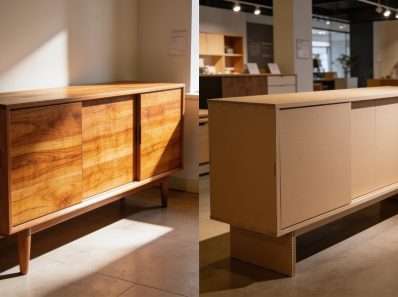
The Natural Oak Cabinet illustrates this separate-storage approach. Its listing gives dimensions of 75 cm wide, 34 cm deep and 80 cm high, with solid oak and oak veneer construction, a matt lacquer finish and no assembly required. It is a cupboard-storage piece, not a coffee table.
Check internal measurements, shelf arrangements, door-opening space and installation instructions before deciding it will accommodate your belongings.
Do not assume it will exactly match another product simply because both have “natural” or “light oak” in their names.
8. Compare Storage Formats by Their Trade-Offs
Use this comparison to narrow your shortlist. These are formats to consider, not a claim that every type is available in our current range.
| Storage approach | Useful when you want… | Check carefully |
|---|---|---|
| Open lower shelf | Visible, accessible storage | Usable dimensions, reach and shelf load limit |
| Shelf with baskets or boxes | Smaller items grouped together | Container fit, removal space and contact with the finish |
| Drawers | Everyday accessories out of sight | Internal size and full opening clearance |
| Lift-top compartment | Concealed storage beneath a moving top | Operating instructions, clearance and intended use |
| Nesting tables | Flexible surfaces that store together | Stored and extended footprints; any shelf limitations |
| Separate cabinet | Storage away from the centre of the room | Internal capacity, door access and fixing requirements |
The right arrangement may involve fewer pieces, not more. Compare what you already own before buying a table, nest and cabinet as a set.
9. Check Fit, Materials and Finish Before Ordering
Test the Table Against Your Seating
Mark the proposed footprint on the floor, then sit down, stand up and walk through the room.
Check whether you can reach the tabletop comfortably and use the storage without moving other furniture. Include drawer extension or lift-top movement in the test.
Do not rely on one clearance figure or sofa-to-table ratio as a guarantee of fit. Your main walking route, seating arrangement and access needs matter more than a generic proportion.
Read the Component Materials
If solid oak is important to your purchase, ask which components are solid oak and where any oak veneer or other materials are used.
Check the top, legs, shelves, drawer fronts and drawer bases rather than relying on the product name alone. Neither a solid-oak label nor a veneered construction, by itself, establishes the quality or suitability of the complete table.
Follow the Instructions for the Exact Finish
Check whether the surface is lacquered, varnished, oiled or waxed, and obtain the appropriate care instructions.
Do not automatically oil a lacquered table or use a general wood treatment without confirming suitability. Ask about cleaning spills, protecting the surface and addressing marks before applying products.
Follow stated load limits and intended-use guidance. Do not assume the table or lower shelf is suitable for sitting, standing or supporting body weight.
10. Keep the Tabletop Useful
Give everyday items an agreed place, then leave enough surface available for the way you use the room.
A small tray can group coasters and remotes. A basket beneath the table can hold selected accessories. Books can stay on a shelf rather than spreading across the top.
Check that decorative objects do not obstruct access to drawers, moving tops or nesting pieces. Use surface protection recommended for the finish, and avoid overfilling storage just because space is available.
The aim is a table you can use without first clearing it.
Your Pre-Order Checklist
Before buying, confirm that:
- You know what the table needs to store.
- The footprint works with your seating and walking routes.
- Shelves, drawers or compartments fit your belongings.
- Storage openings remain accessible in the room.
- Any baskets or organisers fit and can be removed comfortably.
- Nesting pieces work both stored together and spread out.
- Component materials and surface finishes are clear.
- Assembly, operating instructions and load limits are understood.
- The packaged furniture can reach its intended position.
- Delivery, returns, guarantee terms and the full cost have been checked.
Choose Storage That Suits Your Living Room
Start with the storage problem, then choose the furniture that solves it with the least disruption to your room.
An open shelf may be enough for everyday essentials. Drawers may suit a preference for concealed storage. Nesting tables can offer flexible surfaces, while a separate cabinet can take larger items away from the seating area.
Explore our living room furniture with your measurements and storage list to hand. Check each individual listing for current specifications, prices and availability before ordering.