
Choosing between a solid oak sideboard and an oak veneer sideboard comes down to how you live, how long you expect the piece to last, and whether repairability matters to you. Both options use genuine oak timber, but the way they are engineered produces very different results in weight, water resistance, scratch repair, and long-term lifespan.
If you want a heavyweight piece that can be sanded down, re-oiled, and passed down through generations, solid oak is the benchmark. If you need a lighter cabinet with a uniform wood grain that resists seasonal movement at a lower initial cost, quality oak veneer over a stable core has distinct practical advantages.
Before buying, it helps to understand the engineering beneath the surface. If you are comparing actual pieces, browse our solid oak sideboards to check individual specifications, internal dimensions, and joinery details.
Quick comparison: solid oak vs oak veneer
| Key feature | Solid oak sideboard | Oak veneer sideboard (quality build) |
|---|---|---|
| Core material | Solid natural oak boards throughout | Thin slice of real oak (0.6–1mm) over plywood or MDF |
| Weight and feel | Heavy, rigid, substantial | Moderate to light; easier to reposition |
| Resistance to dents | High (Janka hardness rating ~1,290 lbf) | Dependent on the density of the underlying substrate |
| Surface repairability | Full sanding, oiling, and refinishing possible | Surface touch-up pens and waxes only; cannot be heavily sanded |
| Moisture reaction | Absorbs and releases moisture naturally; requires coasters | Edge-banding can swell or bubble if standing water penetrates |
| Expected lifespan | 30 to 50+ years with straightforward upkeep | 10 to 20 years depending on substrate and edge sealing |
| Typical UK price | £450 to £900+ for standard dining sideboards | £250 to £550 for reputable brands |
What is solid oak?
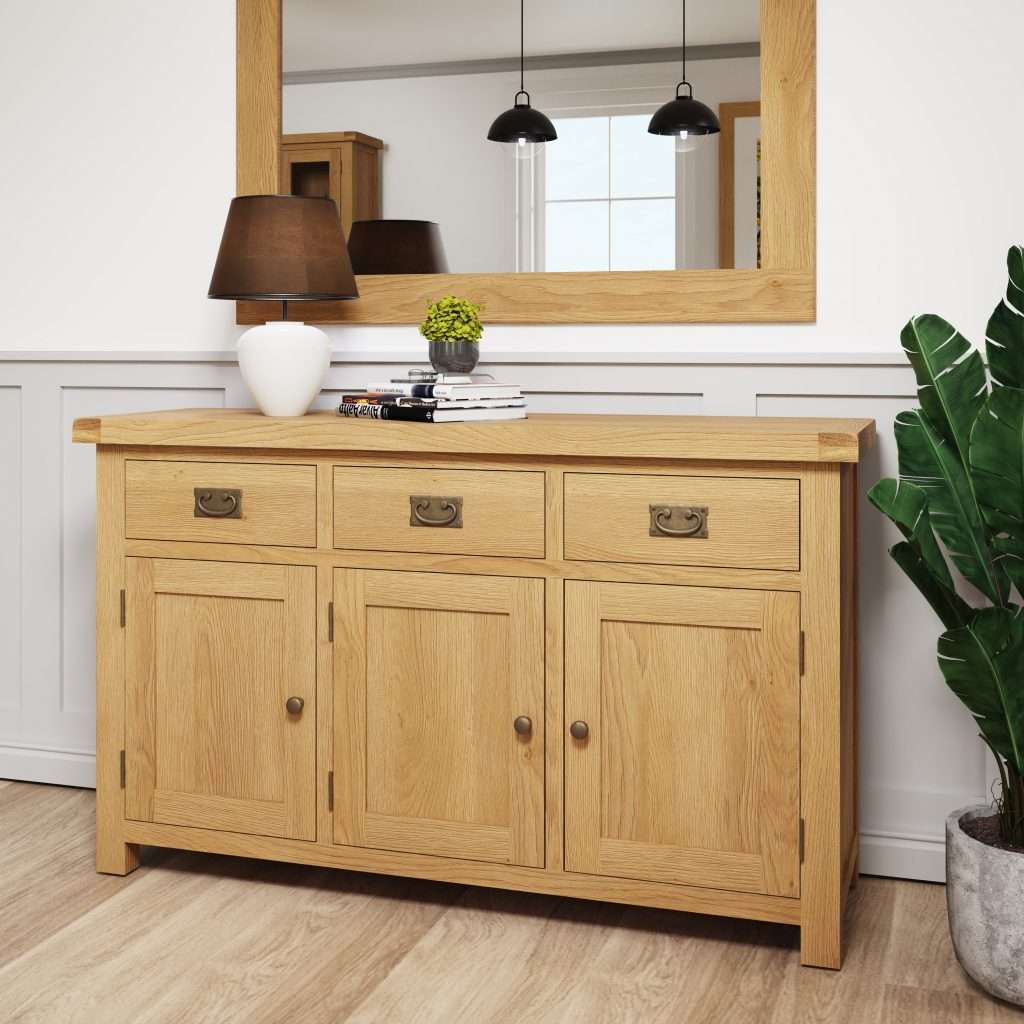
A solid oak sideboard is built from whole planks of sawn oak timber joined together with traditional woodworking joints like dovetails, mortise-and-tenons, and tongue-and-groove backboards. Every part of the cabinet—the top surface, drawer boxes, framework, and cabinet stiles—is pure timber all the way through.
The biggest advantage of solid oak is repairability. Because the wood is identical from the surface to the center, deep scratches, water rings, and daily dings can be sanded out with fine sandpaper and re-treated with wood oil or wax. It also develops a natural patina as it ages, making the timber look richer over decades of use.
The primary trade-off is natural movement. Solid timber breathes: it expands slightly in humid summer conditions and contracts in dry, heated winter rooms. Quality cabinetmakers account for this by using floating panel construction and slotted screw brackets rather than rigidly pinning large panels.
What is oak veneer?
Oak veneer is made by slicing a thin layer of real oak timber—typically between 0.6mm and 1mm thick—and bonding it under high heat and pressure onto an engineered substrate such as multi-ply plywood or high-density MDF.
Because the surface is genuine oak, a veneer sideboard exhibits real wood grain, authentic color variation, and natural texture. The underlying core is cross-layered or uniformly compressed, which prevents the panel from expanding, contracting, or cupping in rooms with fluctuating temperatures.
However, veneer requires careful handling:
- The timber surface layer is very thin, so deep sanding will cut straight through to the underlying board, causing irreparable damage.
- Standing water left along seam lines or edges can seep behind the veneer, causing the glue to fail and the surface to bubble or lift.
- It is significantly lighter than solid hardwood, making it easier to deliver and move into upper-floor flats or narrow corridors.
Beware of “oak effect” foil
When shopping online, look closely at product descriptions. Retailers frequently use ambiguous terms:
- Solid oak: 100% natural oak lumber throughout.
- Oak veneer: A real slice of natural oak bonded over an engineered core board.
- Oak effect / paper foil: A printed photographic paper or PVC film glued over particleboard or chipboard. It contains no real oak timber, feels synthetic, chips easily at the edges, and cannot be repaired.
If a 120cm sideboard is listed under £180, it is almost certainly foil-wrapped chipboard rather than real oak veneer.
3 simple tests to tell them apart
If you are inspecting a sideboard in a showroom or checking a delivery in your home, use these three physical checks:
- Check the end grain: Look at the short edge of the top panel. On a solid oak sideboard, you will see the natural ring patterns of end grain flowing seamlessly from the top surface over the side edge. On a veneered sideboard, the edge is covered by a thin strip of matching tape (edge-banding) with a visible joint line.
- Inspect the drawer construction: Pull out a drawer completely. Solid oak drawers feature interlocking dovetail joints at the front corners, solid wood drawer sides, and substantial weight. Veneered or budget pieces typically use pinned butt joints or cam-locks with thin paper-backed drawer bottoms.
- Lift one end: Solid oak is dense and exceptionally heavy. A 100cm solid oak sideboard generally weighs 45kg to 65kg, requiring two people to lift safely. A veneered MDF piece of the same size typically weighs half that amount.
Which sideboard suits your home?
Choose solid oak if:
- You view furniture as a multi-decade investment that should last 30+ years.
- You have children or pets and need the ability to sand out scratches, stains, or scuffs at home.
- You appreciate the physical weight, dovetail craftsmanship, and natural tactile warmth of solid timber.
- You want the piece to retain substantial second-hand resale value over time.
Choose quality oak veneer if:
- You are furnishing a modern apartment or rental property where lower weight makes moving easier.
- You have a strict budget but still want the authentic visual beauty of real oak grain rather than cheap plastic foil.
- The sideboard will sit directly beside a radiator or in a conservatory where severe humidity swings might challenge solid timber.
- You prefer sleek, ultra-smooth contemporary slab doors that require perfectly flat engineered panels.
For guidance on coordinating wood tones with your space, read our guide to light vs dark oak sideboards. If you have an existing piece with surface wear, our tutorial on repairing scratches and stains on oak sideboards covers step-by-step restoration techniques.